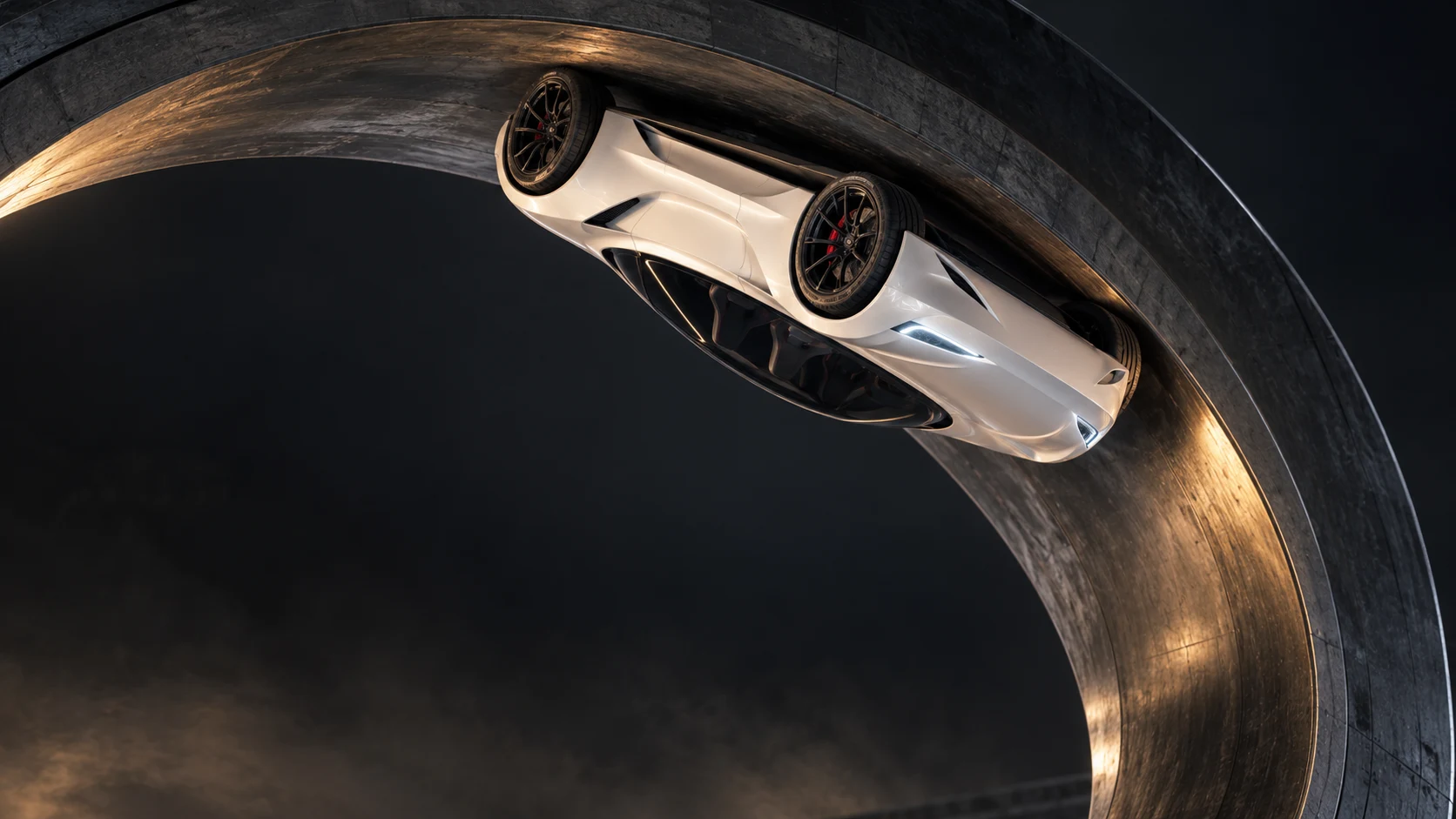
The Tesla Roadster’s upside-down demonstration raises a question that goes beyond its fans and thrusters: what kind of tires can handle a car operating like this?
Tesla’s official materials provide a useful starting point. The company describes a suction system that generates downforce, and its Roadster chart explicitly includes a line labelled “Tire Load Limit.” That makes tire capacity a relevant part of the discussion.
However, the chart does not identify the tires used in the demonstration or establish that an entirely new type of tire is required. Understanding the likely requirements means looking at the tires as part of the complete vehicle.
How Does the Tesla Roadster Drive Upside Down?
According to Tesla, the Roadster uses a multi-mode fan and ground-sealing system to extract air from beneath the vehicle. The resulting pressure difference generates force toward the driving surface.
Tesla also describes cold-gas thrusters for airborne manoeuvres. These have a different role from the suction system that helps maintain contact with a surface. The company lists different equipment for its Performance, Thrust and Rocket configurations, so the demonstration’s capabilities should not be assumed to apply equally to every version.
For the tires, the important question concerns the moments when the wheels are touching the track. During those moments, the tires must transmit the forces needed for acceleration, braking and steering while working with the suspension and downforce systems.
What Tesla’s Tire Load Limit Chart Actually Shows
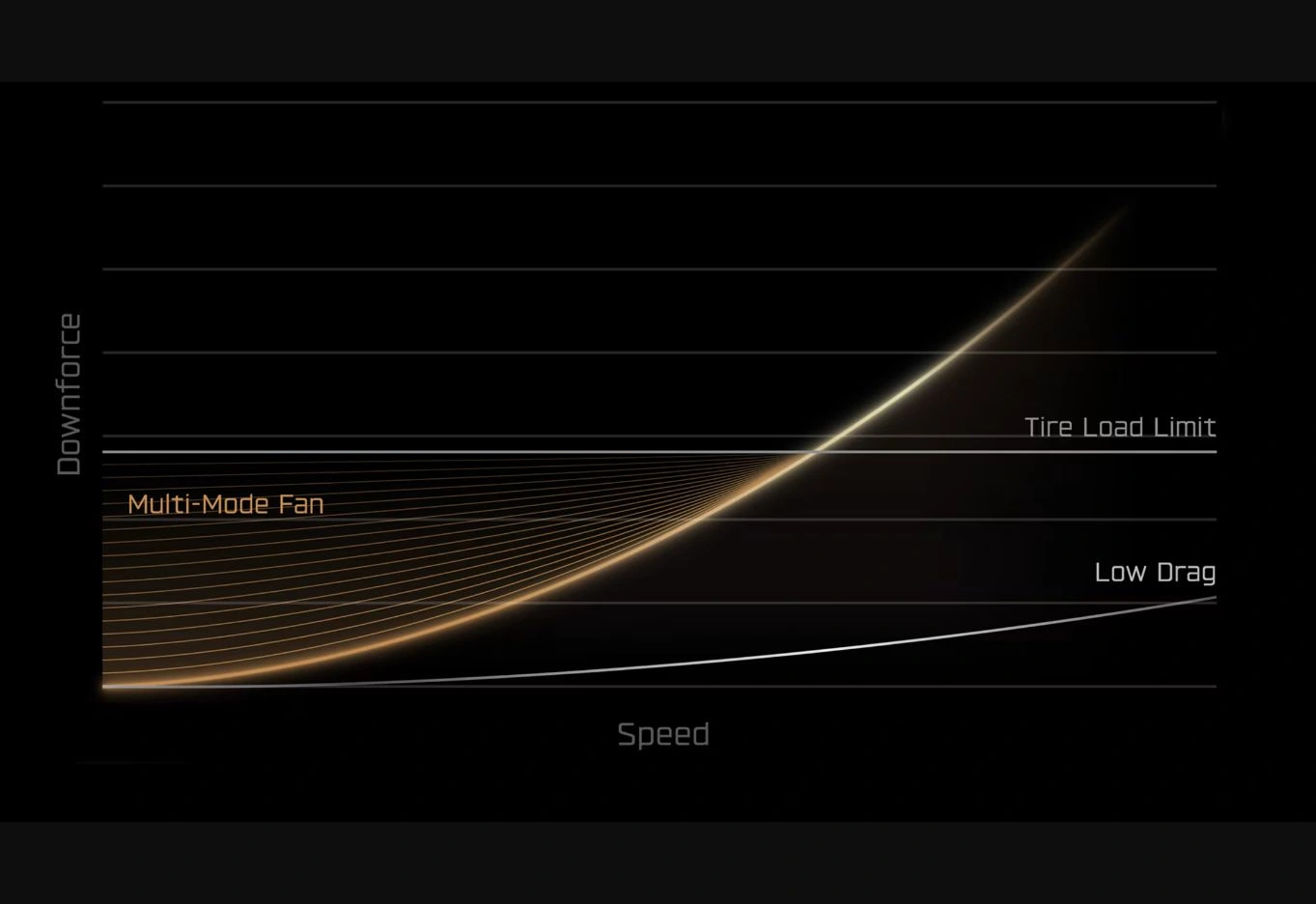
The official image plots Downforce against Speed. It includes curves labelled Multi-Mode Fan and Low Drag, alongside a horizontal line marked Tire Load Limit.
The presence of that line matters: Tesla itself presents tire load capacity as a constraint in its illustration of the Roadster’s downforce system. Our engineering interpretation is that the force pressing the vehicle toward the surface must be considered alongside the tires’ ability to carry the resulting loads.
The image has important limits, though. Neither axis provides numerical values, and the chart does not state a tire size, load index, inflation pressure or manufacturer.
It therefore cannot tell us exactly how much load each tire carries. Nor can the “Tire Load Limit” label be converted directly into a particular tire load index.
What Would Suitable Tires Need to Handle?
The following are engineering considerations for a vehicle with these capabilities, rather than confirmed specifications for the demonstration car.
Grip and a stable contact patch
The tires need to transmit forces predictably during acceleration, braking and changes of direction. Compound, tread design and the way the contact patch changes under load all matter.
These are already development priorities for performance tires. For example, Pirelli describes contact-patch optimisation under high-torque conditions in its P Zero Trofeo RS. That illustrates an existing engineering approach; it does not identify the Roadster’s tires.
Load capacity matched to the complete vehicle
Tire size alone does not establish suitability. Load capacity and speed capability must also meet the vehicle manufacturer’s requirements. Michelin identifies size, load index and speed rating as essential starting points when selecting replacement tires.
For a vehicle using substantial downforce, engineering assessment would also need to consider the loads at each wheel throughout the intended manoeuvres. A static vehicle-weight figure would not describe every operating condition.
Consistent performance at operating temperature
A suitable tire must perform within the temperature range expected during use. Its compound and internal structure need to support that operating environment.
Pirelli’s performance-tire documentation, for example, discusses reinforcement for stability during demanding handling at high temperatures. This shows why suitability involves more than simply choosing a softer or wider tire.
Suitability for the intended surface
A tire developed for a dry circuit is not automatically the best choice for everyday roads.
Pirelli’s technical guidance for its Trofeo R and RS tires identifies reduced performance in cold conditions, heavy rain and standing water. Without confirmed details about the Roadster’s tires and test conditions, describing slicks or semi-slicks as its necessary solution would be premature.
Would Production Require a Completely New Tire?
If a vehicle with these capabilities enters mass production, its tires would need to be developed or validated for the final vehicle’s operating requirements.
That could involve approving an existing tire, adapting an established tire platform or developing a dedicated specification. A completely new category of tire is only one possibility, not a conclusion supported by the chart.
Vehicle-specific tire development is already an established practice. Tesla says it works with tire manufacturers to tune characteristics including handling, range, comfort and noise. That general development process does not reveal which tires were fitted to the demonstration Roadster.
Is This Similar to Choosing Tires for an EV?
The useful comparison is the need to match the tire to the vehicle’s demands.
An electric vehicle does not automatically require a tire marketed with an “EV” label. Michelin explains that the required size, load capacity and speed capability remain fundamental, while EV-focused designs can offer advantages in areas such as rolling resistance, durability and noise.
For the Roadster, the same principle applies. The relevant question is which tire specification satisfies its actual operating requirements.
Tesla’s chart gives us evidence that tire load capacity belongs in that discussion. It does not yet give us the information needed to name the demonstration tire—or declare that a new type of tire must be invented.